NerdTrain 2019

Why Trains?

One of my favorite bits of railroad trivia is that Rhapsody in Blue, known as the United Airlines theme with Matt Damon’s voice coming in to tell you about the friendly skies, was inspired by a trip that George Gershwin took by train to Boston. It’s a song I often listen to while on the train, ignoring another book packed into my bag with high hopes of being bookish. The clacks, bangs, and hums of the rails have never produced a symphony, concerto, or even a song for me yet, but they keep me coming back to ride year after year.
Getting there

This year’s train trip started with a flight. There was not much magical or inspiring about the flight, except for the fact it allowed me to watch an old favorite movie. The flight from Dulles to Los Angeles might be the longest I’ve ever taken. I’ve never been abroad, and rarely go to the West Coast. Every time I do, I curse the error of my own ways.

Flights are filled with lots of time and ways to waste that time. Here are 300 movies. Here’s a tablet for rent. Or headphones to buy. I relentlessly check the map to see where we are, how much of the flight is left, and try to keep basic math skills alive by calculating the percentage of the flight we’ve completed. I talked very briefly at the end of the flight with the woman sitting by the window, who was going to see her daughter and newborn granddaughter. She was certainly happy to arrive and softened her expression as we taxied around the runway.

People talk a lot more once you touch down on planes. I know it’s the calculated risk of starting a conversation with someone when they’re next to you for five hours, but once you land, it’s only 15 more minutes of potential hostage taking to an unwanted conversation. The stress apparent on everyone’s face through security warnings and tiny seats melts in those moments. Things are OK for a little bit, until we all want to get off the plane at the same time.

Golden Times

I landed at LAX and immediately violated a cardinal rule of Los Angeles. I walked. I walked out of the airport. I walked past cars jammed in to an airport driveway at noon on a Thursday, and service workers walking in to the airport. A TSA officer zipped by me going into LAX on a Lime scooter. He certainly seemed to be having more fun than those stuck in their cars.

I walked up to my hotel, less than a mile away checked in early from a status I earn by having a credit card, and tried my hardest to stay awake to adjust to the new time zone. I mused on going to a Ralph’s without a loyalty card, given I had just seen The Big Lebowski the week prior. A fellow pedestrian with a Stonewall Kickball DC shirt reminded me that the world is pretty small. It honestly was a lazy opening to a very busy vacation.

This lazy day around LAX ended up being about the only downtime in California. Dan arrived the next morning and we headed out, through downtown Los Angeles (avoided the 405) and happened upon the first historic site without planning it. The series of tunnels that lead out of downtown LA are the beginning of the Arroyo Seco Parkway, the first parkway of the massive California Expressway and Freeway System and the first freeway in the Western United States. Our experience on it was rather brief, the series of tunnels that serve as the gateway to the parkway, but like everything in LA, they were in movies, and were designed with style beyond what was necessary, which got us both looking up while in traffic.

The journey to the Central Valley had me looking around in amazement at almost everything. My norm in the Mid-Atlantic and New England is non-stop green. There is always green. Green mountains, hills, lawns, foothills, green license plates. Driving over the hills to get out of Los Angeles was a study in different shades of brown and high rates of speed, punctuated with a stop at In-N-Out burger.

I try to reconcile different parts of my knowledge a lot while traveling. Visiting somewhere new challenges what I knew before hand, coming in, with the childlike wonder of seeing something new. I know about California wildfires, and how dry the area is. Seeing that in person? I couldn’t stop looking around. The undulation of the hills. The canyons that seem to go forever. A huge intersection of two different carriageways of one interstate and an intersection with a freeway, all under the cascades of the Los Angeles aqueduct. To see the drinking water of the city, tumbling in the air, down a mountain as a backdrop of leaving the metro area reminded me how much of an engineering achievement the whole city is. A desert fed by water over 200 miles away. The whole system can be as simple as water coming from a faucet (get over it, Marc, it’s just water), but these projects fascinate me.

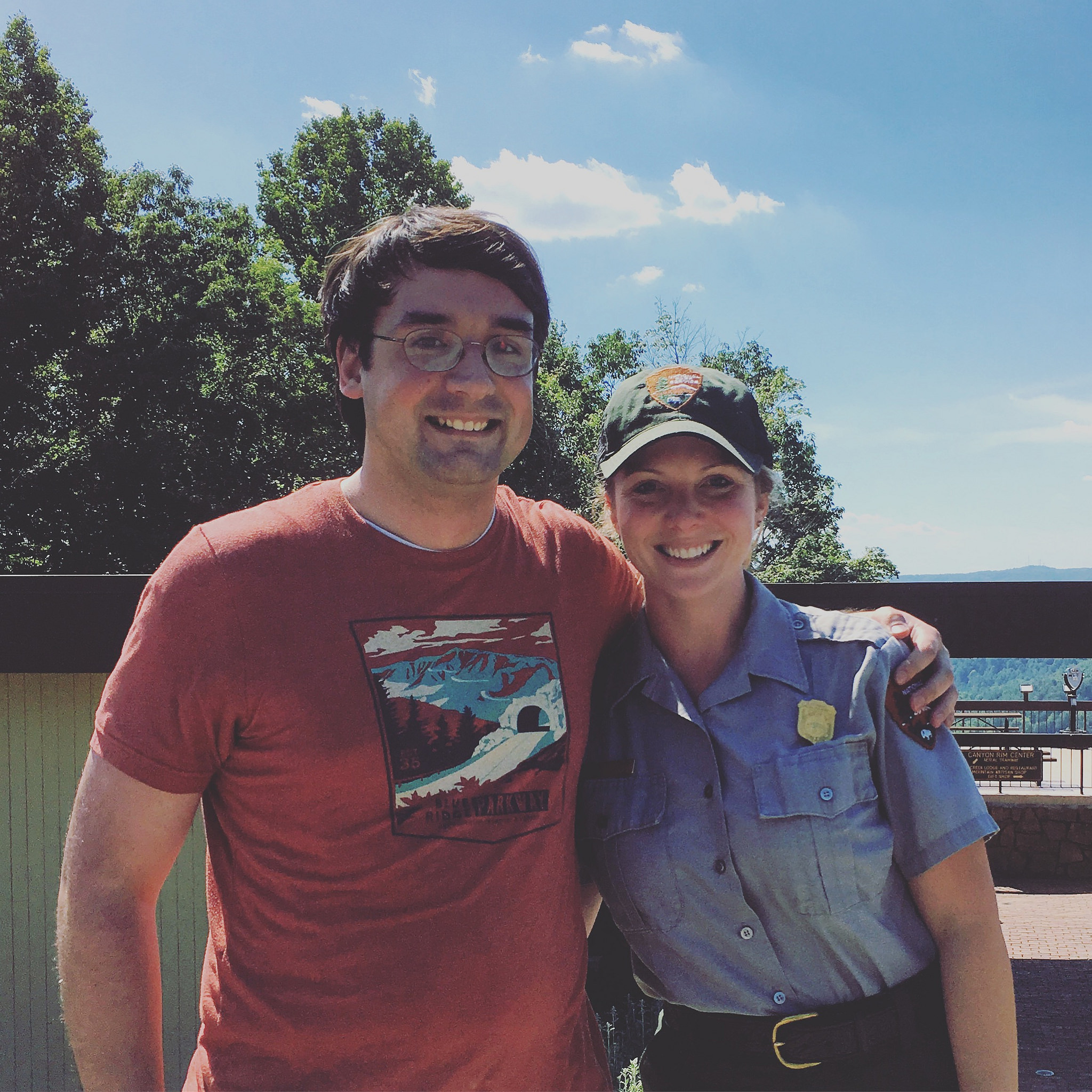
With me taking pictures from the front seat, and Dan driving, we entered the Central Valley’s heat of 100 degrees, and made our way to Kings Canyon National Park. We arrived about mid-afternoon and stopped off at the visitor’s center near General Grant. In true NPS style, a most wonderful ranger Tina guided us for what would be the next two days. What hikes to take around that area, where to drive to, what to see when we go down into Sequoia the next day, and chatted with us as if we were old friends returning to a common love. We certainly weren’t the only people there, but it did not feel crowded, and we set off to see General Grant.

For being the second largest living thing on Earth, Grant didn’t stand out that much because he was in a forest of a lot of his friends. Though the tree was impressive, the grove of all the tress together was more of a statement. I was struck by a stump, left over from a tree cut down to send to the 1876 centennial exhibition in Philadelphia. Those on the east coast, viewing a cross section of a sequoia, could not believe it, and called the Californian who brought it a liar, and proclaimed it a hoax. There was no way a tree could be that big.

I didn’t know of that story before going into Sequoia, but immediately identified with it. How could anyone believe this without seeing it? I had purchased a guidebook for a couple bucks before coming in, but never got around to reading it before entering the park, and I’m kind of glad it worked out that way. To discover based on what the rangers say, and stopping to read the panels added more to the experience for me, though I can’t explain exactly why.

Though General Grant and General Sherman are just so amazingly big, the most humbling moment was hiking into the Crescent Meadow, a beautiful patch of grass standing among giants. We approached from the Congress Trail and walked around the entire meadow to get to the shuttle stop back to our visitor center, and ended at the explanatory sign of the meadow. The simple wooden sign, in the iconic National Park all caps font, proclaimed

CRESCENT MEADOW: GEM OF THE SIERRAS – JOHN MUIR

I had been walking in the footsteps of John Muir, and didn’t know until we reached the end of our hike. It wouldn’t have been hard to reason, we were hiking in the Sierras of the Sierra Club, but the indescribable beauty became more understandable. These were the lands that helped convince the world parks are worth protecting, and that nature is its own cathedral that can heal. I had been to Yosemite as a middle schooler, but wasn’t in any mental state to get it. I probably annoyed my parents and brother more than anything. Taking in the sights Muir enjoyed, and hiking around his gem was something special.

California travels continued on after the Sierras toward the desert, through Tehachapi and a stop to see Cesar Chavez’s homestead with a very close bobcat (Cesar Clawvez?) experience. We wrapped back into Los Angeles taking the 405, and made it back in time for the departure at 10 PM into the California night.

On the Train

Given what I had seen already, it was crazy to think that the trip was just about to start, but I leaned into making this a trip bigger than the past. It was also a trip that I took one day after receiving a new pair of glasses, and honestly, I love them. It really brought me a lot of new confidence, and I took a lot more pictures with me in them after having them on. Part of that confidence also came with being around people I truly felt great around. There’s a refreshing honesty that comes with being around friends that get you. Even with the group only getting together 1-2 times a year, there’s a depth to the friendships, because you have hours to talk on the train about so many things. I’ve laughed, cried, and enjoyed some of the finest moments of my life with friends aboard a trip, and this was no different.

Boarding the train that evening and watching Los Angeles drift away into the night was the start of another time to create and deepen those friendships, though the train also adds some friendships. On the way to El Paso, a couple boarded in Arizona on their way to New Orleans to take a cruise up the Mississippi River. We ended up having breakfast with this couple, and talking about taking the train, and the differences in travel. They were local to Arizona, so they could point out some of the mountain ranges and how to pronounce town names. We were locals to the train, so we pointed out when they could go out and smoke.

I’m generally for chatting up strangers on the train. In the same way as the landing conversations on an airplane, people open up. The difference is, you can get up and leave if the conversation doesn’t go well. If the conversation does go well? You stay in touch months or years later (which has happened!)

This journey was shorter though. Only from 10 PM to about 3 PM the next day in El Paso.

The American Desert

We arrived right about on time in El Paso and immediately headed out toward Carlsbad to go see the bats that leave every evening to go feast on bugs to the delight of every person there. The ranger program began at 7 PM, and we arrived at 7:05 PM, just in time to hear the Ranger say the bats use the cave as a hotel, and then notice the bats had begun. They were early! Sunset wasn’t until 7:30 or so, but they are very strict about using any electronics during the bat flight, so the Ranger had to cut off his microphone.

For the next hour, we sat at an amphitheater looking at the cavern opening watching thousands upon thousands of bats. They corkscrew out of the cave, spinning up and around toward the sky. I tried to trace some of the bats, and it seems so easy, but they scatter into the night sky so quickly. Thousands of bats, streaming from one spot that suddenly all disappear into the desert night. Our group then disappeared into Carlsbad, in desperate search of a place to eat that was open past 9 PM. It turned out to be a tall order, but we ended up at a Japanese place, where I slathered my chicken hibachi in A-1, as we listened to country music.

The next two days were going between the Guadalupe Mountains in Texas, and exploring Carlsbad Caverns. The mountains were formed out of a coral reef, from millions of years ago that formed into limestone. The same mountain range continues and is above the caverns in New Mexico, making it one large diagonal line of parkland through the desert.

It’s a different scenic beauty than I’m used to, and different than the golden views of California. We happen upon springs that have turkeys, roadrunners and deer near by. We hike into a canyon fed by a river and stays a green oasis in the middle of the desert. There’s even a fall that takes place in the Texas mountains near the border. For the first time, I drive a car in my birthstate, and go 80 miles an hour through the Texas desert on our way back into El Paso.

We see an entirely different form of desert to go see White Sands, and dig our feet into gypsum sand. It’s cool to walk on, and even gets damp as you dig in a few inches. I rented a saucer to slide the down the dunes, but it definitely doesn’t go as planned. The benefit is really good expressive pictures of each other as we slowly slide down the dune.

A whirlwind around New Mexico and El Paso leaves us seeing the memorial to the friendship of the United States and America and Mexico, and getting a Blake’s Lottaburger (as opposed to a Whataburger.) We end up arriving back at the station with about 30 minutes to spare before the train arrives, totally using all of the time between the train portions.

On the Train Again to New Orleans

Boarding the Sunset Limited brings on a comfy mood. The entire group is now on board, and we squeeze far too many people into a Family Bedroom built for four on the train to chat and catch up. The El Paso suburbs pass by as we talk, and head further south into Texas towards Alpine.

Dinner that evening is an absolute joy, with some candid photos looking like an ad for Amtrak. Laughter and jokes come easy among us, and though I can’t remember the topics anymore of conversation, I can remember how I felt. So authentically appreciated and understood, and just happy to be around friends. I feel like I can’t describe more without repeating myself, but I hope everyone has friendships like these to be able to understand and be understood.

The next day brings us into Houston, where, as we’re all photographing a passing transit vehicle, two recently boarded passengers ask if we’re NerdTrain. It’s a beautiful moment to be recognized and pick up two more people to join our group. The discussion continues onto what Houston has done for transit and what will do.

As we come into Louisiana, a mother and son start playing cards near by us in the Lounge Car. The mom got up and looked over at us, “hey train nerds, where’s the bathroom on this car.” Of course we all knew, and then started chatting more with her. She was from New Jersey, her son lives in Arlington, VA. Little did they know how much transit expertise they were sitting next to. We talked about Penn Station, NJ Transit, the new Hudson Tunnel, and WMATA all in the time to arriving into New Orleans. I think we proved to be such good ambassadors for transit that she asked for a picture with all of us right before we arrived.

Arriving into New Orleans came with the annual tradition of Matt reading Travel by Edna St. Vincent Millay:

The railroad track is miles away, 
    And the day is loud with voices speaking, 
Yet there isn't a train goes by all day 
    But I hear its whistle shrieking.

All night there isn't a train goes by, 
    Though the night is still for sleep and dreaming, 
But I see its cinders red on the sky, 
    And hear its engine steaming.

My heart is warm with the friends I make, 
    And better friends I'll not be knowing; 
Yet there isn't a train I wouldn't take, 
    No matter where it's going.

From there, we went our separate ways, another NerdTrain completed. Everyone’s different schedules dictated what happened in the city and there was a little less coordinated activities than we had a in the past. But we had a lovely brunch and then exploring around Bourbon Street on a Saturday night, finished off with Beignets.

I stayed until Monday morning and caught a train back to Washington, DC on my own. After being around people for a week and a half, a train ride alone was a different note to end my journey. I had a wonderful table for breakfast leaving Louisiana and Mississippi, with a woman born in New Orleans leading the discussion about the city, a fellow southerner offering his thoughts and myself and a Californian who had been on the train with us from Texas into New Orleans. It was like being around old friends again too, laughing and talking about different regional customs, and the native NOLA resident happy and impressed that I found the Parkway Bakery to go get a po’boy sandwich.

Sadly that proved to be the only good group for chatting I got coming home, and the rest of the time was in my roommette, listening to music or reading. The playlist home came from NPR, with a list of American Anthems, music that has helped define us as a country. I couldn’t help but sneak in Rhapsody in Blue in there as well, but the list provides ups and downs. Some songs of protest, some songs that defined culture and music, songs of joy, and songs of loss. It had been a while since I had listened to sadder songs before, and found myself tearing up, watching the world go by. It’s was not my expected end to such an adventure, but allowing myself time to decompress and fully engage with music that’s typically a background to journeys on the metro was cathartic.

I was ready to come home by the time of our arrival in DC, and eagerly took photos of the passing monuments going over the Long Bridge (as my attendant reminded me, “You LIVE here!”) In the last moments before going into a tunnel that would bring me into Union Station, I saw a mom racing up a ramp with her young son to catch a look at the train. I furiously waved at them, catching the mom’s eyes first and then her son, and waved more with some pointing. The clacks, bangs, and horn of the train catching the attention of another person before we disappeared into the tunnel.

I feel fortunate that the spark of the child hasn’t left me yet either. I’m still excited to see trains go by, and to step aboard a train on a journey of almost any length. I hope sincerely this is something that never leaves me as long as I live.

Posted in National Park Service, Uncategorized | 1 Comment

Clara Barton National Historic Site – May 4, 2014

Where an adventure began.

In May of 2014, I had just finished up all of my coursework for a graduate degree, and was looking for something other than homework to do on weekends. I had visited all the state capitols within a day’s drive of Washington, DC at that point, and been to a few Civil War battlefield, but with no solid plan on what to see.

I knew of the Clara Barton National Historic Site in Maryland, not that far away, and I remember waking up a bit late in the day and wanted to go do something with a free Sunday. I had purchased a new SLR camera not that long ago, and was looking to try that out as well. (Sadly the site is currently closed for renovation, but should open soon).

I didn’t know it at the time, but that pleasant Sunday at a historic home was the first site of a years long adventure across the country into history, nature, and learning more fascinating stories.

14110305174_82959f99d3_c

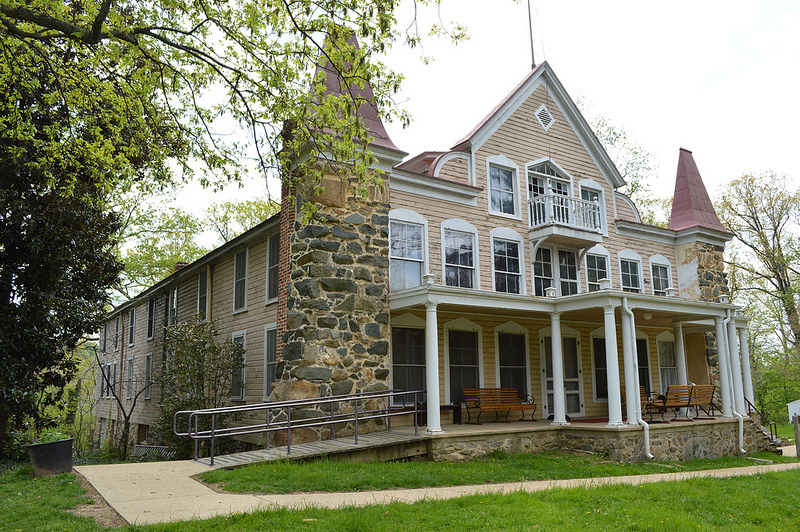
The Clara Barton site sits just over the border from Washington, DC into Maryland. The building itself was made of materials from emergency housing after the Johnstown, PA flood in 1889. The building is bigger than a normal home: it really looks like a big warehouse, and it becomes evident that it’s more than just a “house.” This served as the headquarters of the American Red Cross as well as Clara Barton’s house, and represented how Clara saw no barrier between her personal life and her professional life.

13923198368_7e51dc0c7b_cThe house tour goes from room to room, highlighting the mixture of this personal and professional roles into who Clara Barton was. The welcoming parlor features a USA flag with a Red Cross flag. Barton’s office features her original desk with a bomb fragment from the civil war that she used as a paperweight.

There is also down to earth practical use for the Red Cross supplies: gauze is used to hang lanterns. Colorful windows along the side of the building are used to bring in light, but also allow warm air to leave the building and cool the warehouse in the summer.

This slideshow requires JavaScript.

The displays of this dedication to work are easy to believe for anyone living in the Washington area. One of the maxims that held true for a lot of folks in the area is here, we live to work, as opposed to working to live. I didn’t think too much of this when I was visiting four years ago, but it seems appropriate as the first park I went to on my quest. I’ve certainly enjoyed the jobs I’ve had in life, and believe strongly in the missions of the organizations I was in, but I certainly do not share the mindset of living your work every day. I’ve enjoyed so many journeys outside of work, and particularly like being able to switch off after work and focus on the riches of life.

Clara Barton’s house shows us an incredible woman that does the opposite and threw herself into work, and is outstanding for that reason.

This slideshow requires JavaScript.

The post script to this visit is, at the very end of the tour from the volunteer, we go to the small bookstore. In looking over some items, I pick up a Red Cross flag to remember the visit by, and the volunteer told me about the Passport to Parks program. I had seen it a few times, but having someone tell me about his journeys convinced me to pick up my first passport. I still have that, and have now visited 180 different national park sites, with over 200 more to go.

I would late find out the volunteer that pushed me to pick up my passport was also part of the National Park Travelers Club I joined online. In the forums of the group, I saw that he had visited all 411 parks in the system, and had a ceremony as he walked to the newly dedicated Martin Luther King Jr Memorial. I was unable to attend the ceremony, sadly, but traded some nice notes with Ranger Dan who got my interested in this adventure with these two stamps:

13923188000_9bdd2108c8_c

Posted in National Park Service | Tagged | Leave a comment

Barrier Islands Trip – Reconstruction Era National Monument – January 12, 2018

What does Freedom Mean?

In the waning weeks of the Obama Presidency, the President signed into law three new National Monuments to preserve and interpret sites related to civil rights around the country. This visit turned out to be much more profound than I expected, and stories that still keep me tearing up, so here we go:

Of the three sites Obama created, two of the sites are located in Alabama (The Freedom Riders National Monument, and the Birmingham Civil Rights National Monument) and the third is in South Carolina and interprets the Reconstruction Era.

All three sites are works in progress, trying to construct visitor facilities and work with local partners to tell the story. I was in the midst of travel planning for the Martin Luther King Jr. holiday and found out that for the 1 year anniversary of the National Monument being designated, there would be events all day, and the visitor center would open briefly for the first time.

28025313359_e857fccdb4_z

Open! One Day Only

The Reconstruction Era is arguably the most misunderstood, or least understood, time periods in American history. I remember learning it as Radical Republicans against President Andrew Johnson, and that it was largely seen as unsuccessful with the rise of Jim Crow and the KKK. I thought much more in concrete terms of literally rebuilding a broken South, but I didn’t see the stories of how an entire nation of people became Americans.

Why Beaufort, SC and what’s Reconstruction?

The idea that one site can encapsulate an era in the entire country seems like a tall order, but looking into what Beaufort offers, it’s clear, this is the place. As the Union troops advanced into South along the coast in 1861, plantation owners started to flee, but their slaves refused to leave with them. The Union Army was soon in control of the sea islands, and 10,000 slaves. Suddenly slavery was over, but now what? The Union Army still thought of slaves as being contraband, property of the enemy.

The National Trust For Historic Preservation interviewed the leader of a church in the are on what Reconstruction meant:

“The arrival of Union troops can best be described in Biblical terms,” Pastor Murray offered. “For many years slaves had toiled on the plantations dreaming of the day that Moses would tell them, ‘You’re free.’ In 1861, when Union troops captured nearby Port Royal and the plantation owners fled to the mainland, that day arrived. But what next?”

The plan by the Union Army was called the Port Royal experiment, and it was to try and have freed slaves become self sufficient and independent to work the land abandoned by the plantation owners. This was a shift away from previous views of slaves as contraband property, or even returning slaves to their owners. The experiment had its most joyous moment with a celebration of the Emancipation Proclamation, and a bitter end with President Johnson deciding to end the experiment in 1865 and giving land back to plantation owners. Slowly, the rights of African Americans would be chipped away at as the federal government retreated, and in 1895, the state of South Carolina ratified a new constitution that would severely restrict the voting rights of African Americans.

The Beaufort area has examples of how the experiment worked, and places to ponder what might have been, with three sites being the focal points to visit today: a school complex with roots dating back to 1862, the city visitor center and surrounding historic neighborhood of Beaufort, and a site in Port Royal where one of the first African American regiments was mustered into duty at a ceremony that makes my heart swell. Here we go with the sites I saw:

Beaufort Visitor Center (and a reason to return)

The fire station visitor center was only open that one day I was there as a special anniversary event. I certainly hope to come back and visit when there is a more permanent presence for the Park Service and to learn more on Reconstruction. The city’s visitor center is across the street in an old arsenal building that is a neat spot in the center of a neighborhood. There is a museum inside that tells the story of Beaufort, from the early exploration of a French explorer, through the Revolution, Civil War, Reconstruction and beyond. There is still a strong military presence locally, and I would like to return to see Parris Island.

39093720214_3a79bb1817_c

Beaufort Arsenal

The other spot I need to go see is the house of Robert Smalls. Smalls was born into slavery and was hired out to work in Charleston and learned to pilot ships. After the Civil War started, Smalls piloted a Confederate ship out into the harbor, knowing the locations of all the Confederate mines and forts, and sailed right to a Union ship waving a white flag from a mattress. The ship was taken as a prize, and Smalls became a hero to the Union. He continued to work for the Union navy around South Carolina, and eventually purchased the home of the family that owned him. He became active politically, and ran for Congress serving 5 terms, even after the protection of the federal military in Reconstruction. His home is in the historic area of Beaufort, and not currently open for tours (but it is apparently for sale.)

Penn Center

South Carolina had outlawed teaching slaves how to read or write and there was an immediate need to have schools set up for the freed population. Help came from northern states, with two women from Pennsylvania arriving to set up the Penn School.  By 1864, the school had it’s own buildings on an island in the Beaufort area, with support from a church nearby that still serves congregants today. The Penn School story could have ended when President Andrew Johnson refused to continue the Port Royal experiment, but the teachers from the north stayed, teaching vocational skills and liberal arts to the community.

There’s much more to the Penn Center story, but the other notable part that is worth mentioning is that Martin Luther King Jr used the center with other civil rights leaders as a base of operations. Though it’s tough to know for certain, with King visiting the center so often, it’s claimed that early drafts of his I Have a Dream Speech were written there.

Visiting today is centered around learning about the Penn School and the activities after. The only original building in the area is the Brick Baptist Church which was built by slaves, and then taken over as the community church in 1861. The Penn Center visitor center and museum sells items printed in the Gullah language and cultural items from the area. The Park Service holds the title to Darrah Hall built in 1903, which is the oldest building on the campus today.

This slideshow requires JavaScript.

Port Royal

This site was a special treat, since the area is not usually open for the public to visit. The land that was formerly plantations that became part of the experiment is outside the city of Beaufort. Today, it’s mostly covered by a Naval Hospital, meaning it’s a restricted area, and there’s no chance to see it.

The anniversary events opened the gates to a site just outside the fence of the hospital, which surprisingly featured the remains of Fort Frederick, built by the British in 1730, and made of Tabby, sort of concrete made from shells. The site is preserved by South Carolina, and is usually gated, but it was opened up with rangers explaining the area. It wasn’t my goal to see the remains of the fort, but it was neat to walk around the walls of something almost 300 years old, and a reminder that geography shapes a lot of this history: crossroads and harbors are always important.

39093688764_b3e7eac695_c

See the shells?

The site’s relevance to Reconstruction was just inside the fenced hospital grounds. In 1863, an elaborate ceremony was planned to announce the Emancipation Proclamation to the community of African Americans that had been working in the area. The proclamation had been announced by Lincoln in September, and it was to take effect January 1, 1863. General Rufus Saxton (great name), decided to make it an event, and also celebrate his recruiting efforts to organize a company of African American soldiers.

He ordered more molasses and tobacco brought in, and had hundreds of loaves of bread baked, and oxen roasted to feed a crowd. Over 5000 people showed up on January 1 for the ceremony.

The ceremony started with prayers, and and speeches, and then the reading of the Emancipation Proclamation. The colonel of the First South Carolina Volunteers, a regiment composed of escaped slaves, received a United States flag, and their regimental colors on stage. Just as the colonel was going to make his remarks,

an elderly freedman in the large audience surrounding the platform spontaneously broke into song, and was soon joined by most of the blacks around him, singing: “My country ’tis of thee, Sweet land of liberty, Of thee I sing!”

The stunned colonel and dignitaries sharing the platform listened as the blacks sang, and Higginson (the colonel), commented in his diary that night, “I never saw anything so electric; it made all other words cheap; it seemed the choked voice of a race at last unloosed… Just think of it! — The first day they have ever had a country, the first flag they have ever seen which promised anything to their people… the life of the whole day was in those unknown people’s song.” Colonel Higginson responded by saying any words he might speak would pale in comparison to what had just happened…


The colonel himself recorded in his diary at the end of the day, “So ended one of the most enthusiastic and happy gatherings I ever knew. The day was perfect, and there was nothing but success.”  – Camp Saxton Site National Register Listing

I was able to get some pictures from far away of the historic marker that supposedly marks the tree that was at the center of the ceremony. I hadn’t fully comprehended the significance of the site when I arrived, I just knew I was able to go somewhere that wasn’t usually open. As I read more on site, I realized just what a tremendous occasion happened there. With that, I got into my car and continued on, wishing I had done a little more digging before I visited, but glad I did anyway.

25880977988_75de2bfb36_b

Posted in National Park Service | Tagged | Leave a comment

Bluestone National River – June 3, 2017

This visit starts from a ranger I met when I stopped by the Sandstone Visitor Center in southern West Virginia in September 2015 after trading cars with my dad in Kentucky. I chatted with the ranger there for a bit about state parks to visit and how beautiful it was on I-64. I returned again in April of 2016 to look for more hikes around, and the ranger remembered me from September (and I was taken aback and surprised!). She told me about a National Trails Day 10 mile hike along the Bluestone River in West Virginia and I decided to go. June comes along and she arrives at the hike and smiles huge “you came!” and we talked a bit along the way and I had a great time all around.

About three weeks ago, I remember, it’s the first weekend in June coming up (National Trails Day, first weekend in June!), so I call the visitor center to see if they’re doing the hike again. Ranger Abby answers the call, tells me she’s leading it again, and says, “I remember your voice! You’re the guy in DC that runs marathons right?” I just had to go hike again right?!

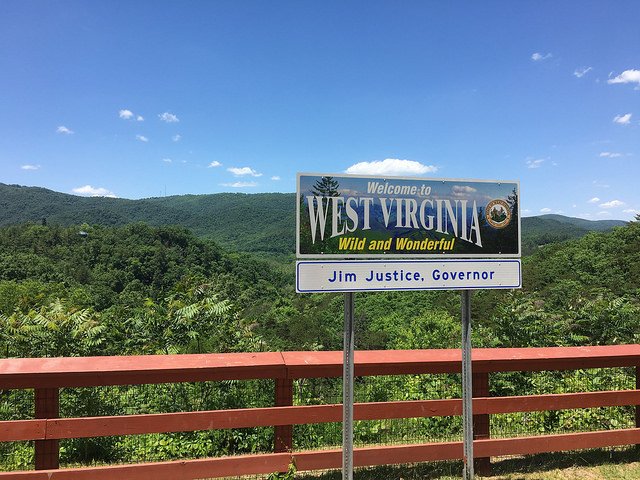
I took off from Washington, DC on Friday morning (with a brief driving visit through Rock Creek Park, the National Mall, and over the George Washington Memorial Parkway) and headed out to Wild and Wonderful West Virginia.

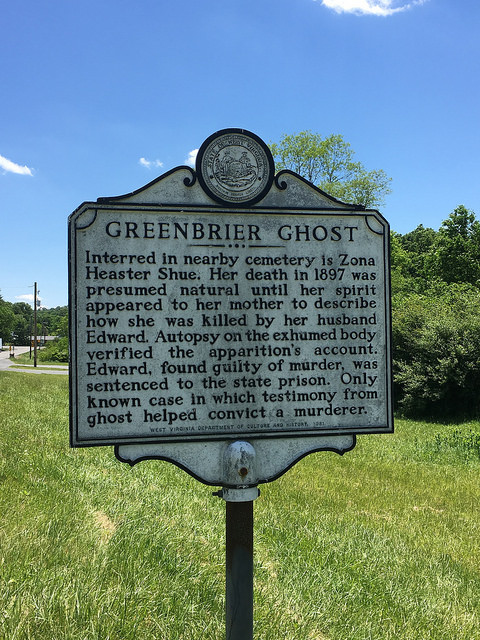
The drive along Interstate 64 is just spectacular after heading west from Lexington, VA. The West Virginia portion quiets down a lot, and it’s just the rolling hills and you for some parts. I recently picked up a West Virginia book that listed all of their historical markers and made a stop over at Sam Black Church to take in the story for the Greenbrier Ghost. That last line is a thinker.

Continuing along I-64, I made my way back to the Sandstone visitor center and arrived to a cheerful “Marc! You’re here!” from Ranger Abby. We caught up a bit, and talked over what I should do with my afternoon, since I arrived at about 1 PM. I’m also a member of the West Virginia State Parks VIPP program that allows you to get a patch and gift card for visiting state parks, so she suggested a loop with Babcock State Park and the Nuttallburg site in the New River Gorge. She told me I had to go see the Whipple Company Store sometime too, but sadly, not enough time this year.

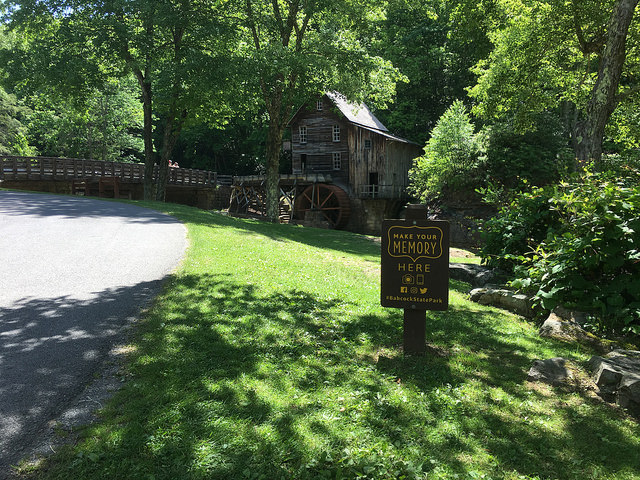
I headed north to Babcock State Park which features one of the most photographed spots in WV: a grist mill along a river. It’s as charming as I thought it would be, with some heavy suggestion you take pictures and share them. As a side note, I’ve found every WV park to have friendly staff and memorable experiences and views. If you are going through to find the NPS sites, the WV state parks are worth it too, and they don’t charge admission!

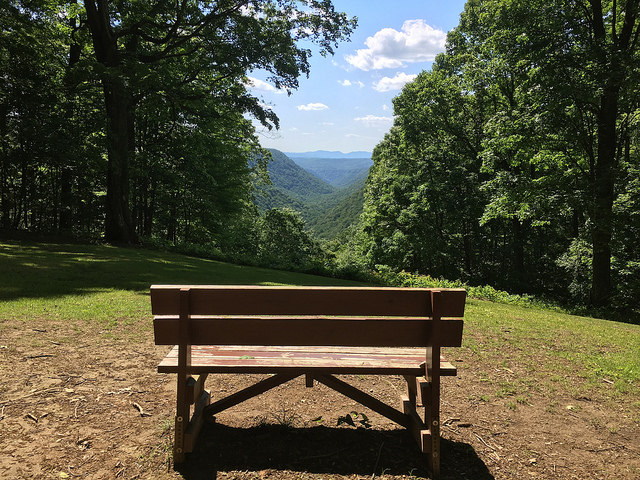
Babcock State Park also has overlooks that were just stunning. For more than a few moments, I pondered whether I should go back home at the end of the trip on this bench

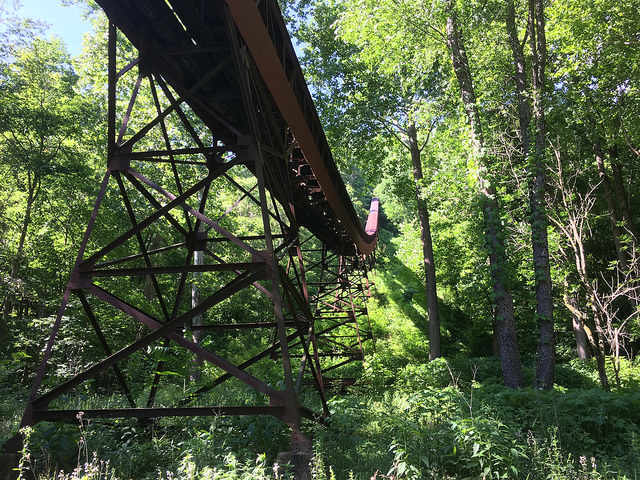
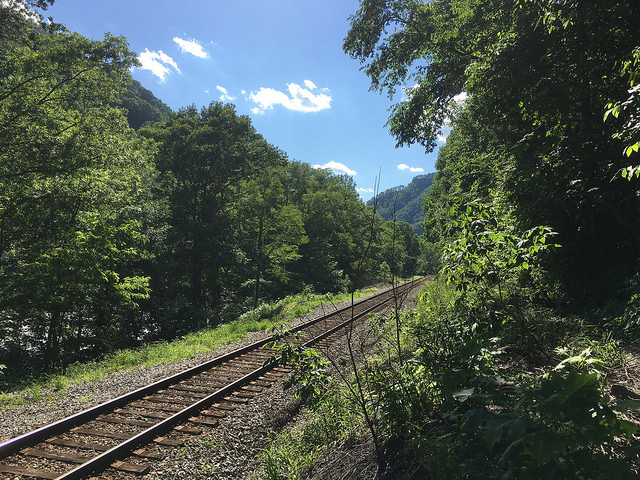
But there was more to see! I pressed on to Nuttallburg, which is a very harrowing drive in a four door sedan with DC plates. I could see everyone in the small towns I passed look twice at my car. There were more than a few signs saying the road was closed, but I’ve found that those signs can come down a little late after a road has opened back up, so through some very heavy potholes, gravel, and some low tree trunks, I made it to the abandoned town of Nuttallburg. Nuttallburg is worth a stop to see coal communities as they once were. The tipple and coal conveyor are still in tact and loom over the area. There are foundations of houses that used to be around the community and the foundation of a bridge that used to cross the New River. The railroad still passes by, and the Amtrak Cardinal travels through the New River Gorge on it’s way to Chicago from Washington, DC & NYC.


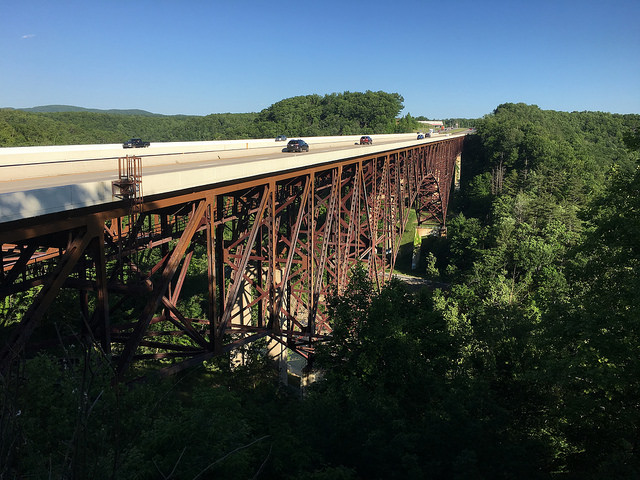
I walked around alone for about an hour before moving on from Nuttallburg. By the time I made it back to US 60, it was after 5, and I knew I wouldn’t be able to get into the visitor center at the rim, so I decided to just keep moving. I enjoyed the view from the arch bridge as I passed by at 50 mph, which always reminds me of the Blue Ridge Parkway “Enjoy the View, Watch the Road!” I kept going south towards Beckley and the West Virginia Turnpike until the Bluestone River crossing to get a sneak peek at the gorge I’d be spending all day Saturday with.

I made it to Pipestem State Park in time for dinner. The Friday night special is a seafood buffet. Ignoring several warnings and “I wouldn’t do that’s…” from friends, I went in for the buffet, and got about 5 plates of food, looking over the Bluestone River Gorge and thinking about how much I enjoyed the day.

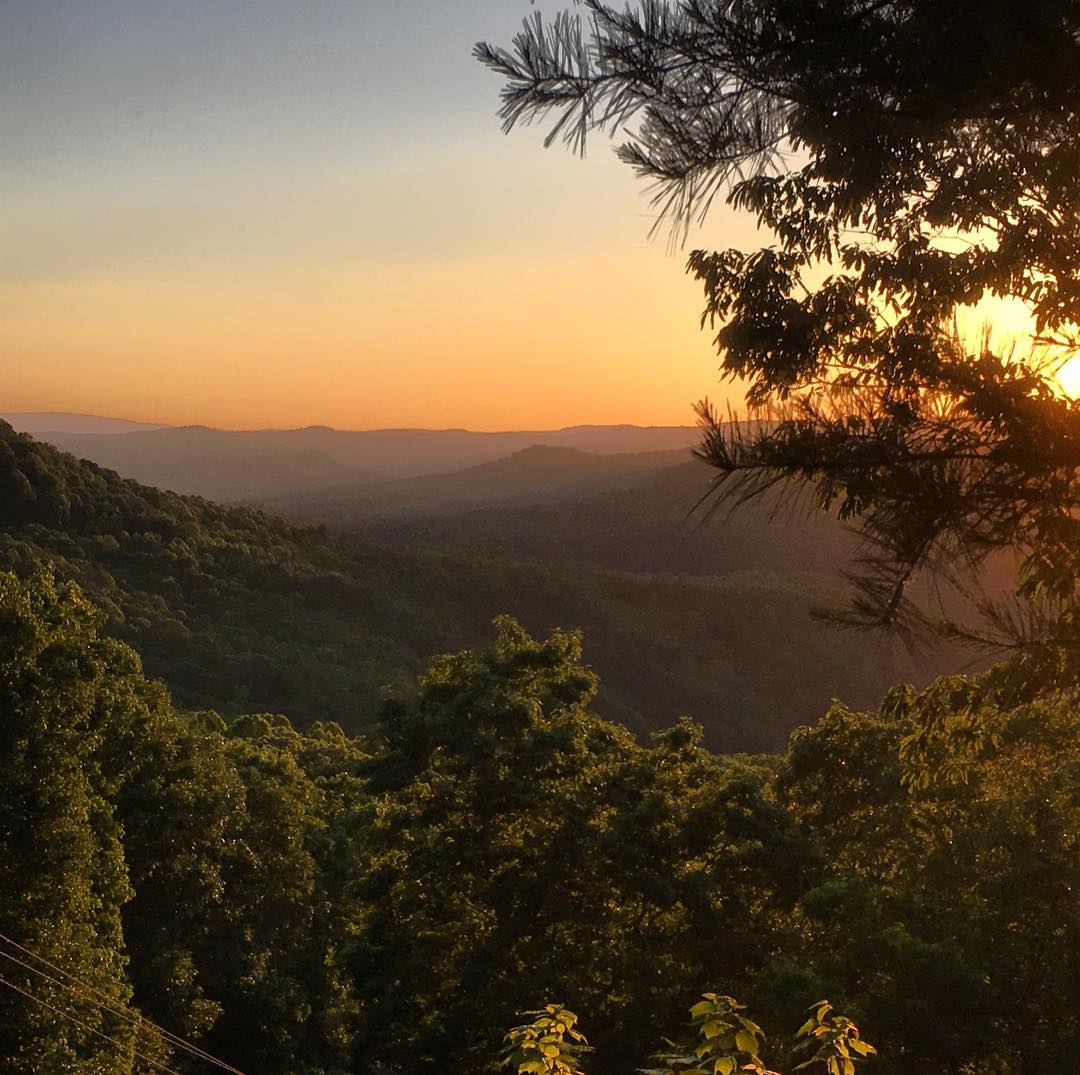
I went for a walk along the park road to an overlook to take in the late June sunset, and it did not disappoint.

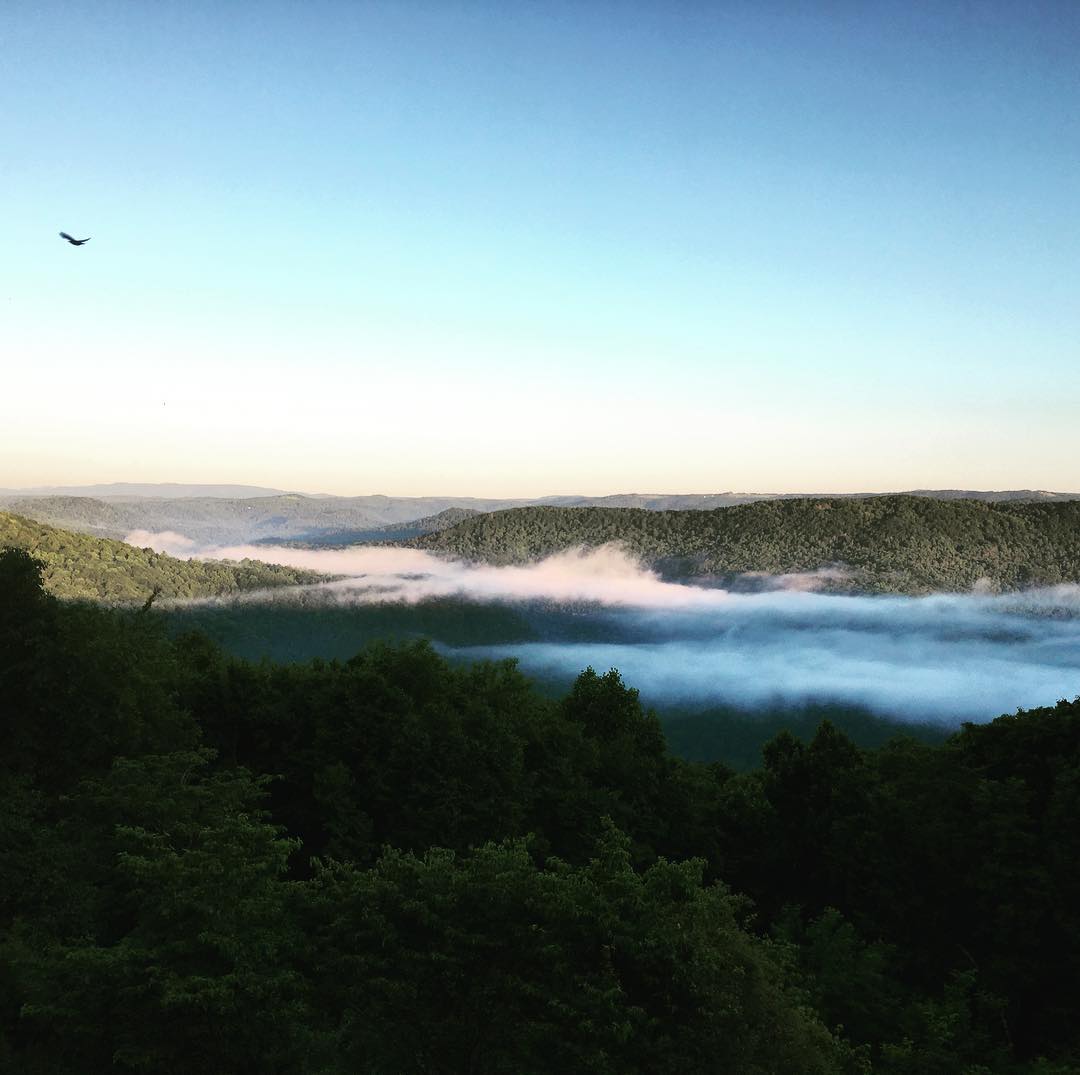
After sunset, I went back to my room, and looked down at 2 raccoons staring at each person on their balcony looking for some handouts. I enjoyed seeing stars again for an evening, and noticed fireflies dancing around in the forest. I left the blinds open so I’d wake up to catch some morning views, as I recalled seeing a fogged in gorge last year, and once again, I got lucky for a beautiful view from my bed at 6:30 AM:

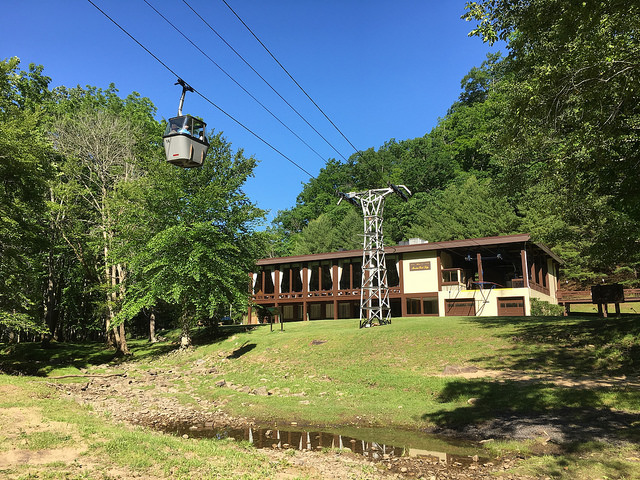
I got about another 90 min of snoozing in before I headed out to grab a sandwich and supplies for the hike. The hike itself started at the base of a tram that takes you down into the gorge. There’s a lodge and a dining room for guests that want to stay next to the river. It’s a tiny little gondola carriage ride to the valley, but it has some great views too! The ride down is free, the ticket back up is $7. Luckily, the hike ends at another state park where a bus will be waiting to take us back to Pipestem.

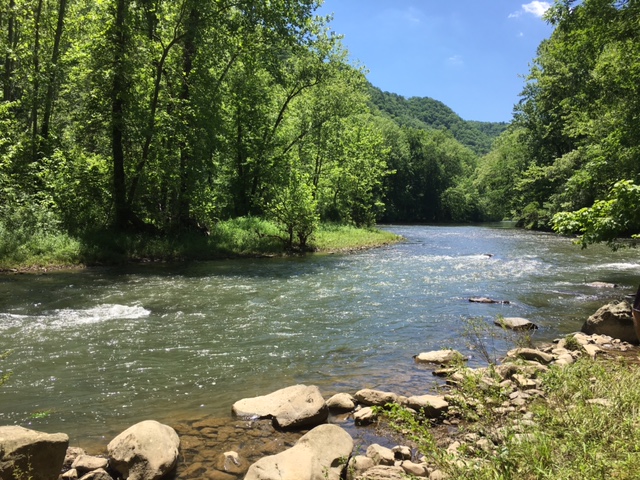
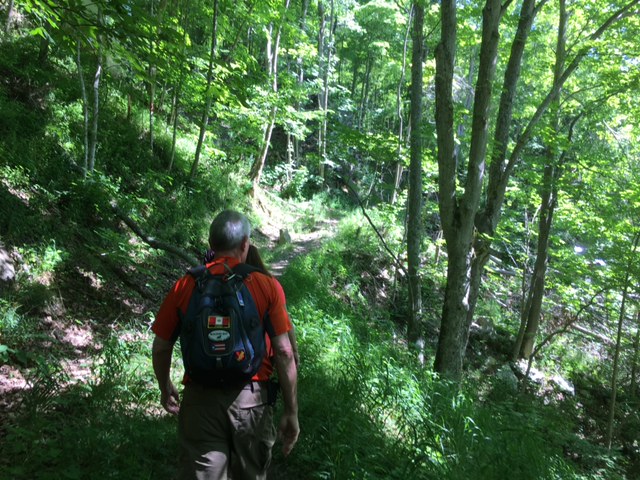
The hike began at 10 AM with some introductions and a little info about the area, and then we were off for 10 miles along the Bluestone NSR! The trail is mostly flat, with some ups and downs, and the occasional muddy patch. They’ve had a lot of rain recently, and all the river pictures are at 3.5 feet depth. In the past weeks they hit 9 feet, with trees along the trail showing signs of mud up to our chests. The state park portion through Pipestem was a little overgrown, but the ranger had called in for her maintenance guys to clear the path. Thankfully they came in and cleared off the NPS managed areas making the remaining 7 miles much easier to hike through. The hike stops at a group of rocks for lunch, and goes to the lost town of Lily, where the only road access to the Bluestone is. Lily was named after the Lily family and the town was relocated due to the Bluestone dam that was being built upstream. The river did not end up flooding where Lily was, but the only remains are one stone foundation. Today, there’s a restroom and some trash bins maintained by the NPS.


About 30 of us finished the hike and ended up at Bluestone State Park where a river rafting school bus was waiting for us with cold water and a smile. I was able to get 2-3 miles to chat with Ranger Abby and Joseph, talking about their previous ranger posts, and what they liked about WV. I’m working on pronouncing the Kanawha River correctly as well (CAN-aw). I told Ranger Abby that the National Park Service actually retweeted my last week when I participated in a Twitter chat about National Outdoors Month plans (About 20,000 people viewed the tweet!) Being tradition now, we took another photo for 2017, and then I was off on a 5 hour drive back home.

Posted in National Park Service | Tagged | Leave a comment

Barrier Islands Trip – Santee Wildlife Refuge – January 12, 2018

Over Martin Luther King Jr Day holiday, I took off early from work and went south to visit some of the barrier islands and fortifications preserved along the Atlantic coast. I got out of work early on Thursday and made it to Lumberton, NC to get a better jump on Friday travels.

I got up and out early on Friday, and made my first stop at the Santee National Wildlife Refuge. I’ve grown to enjoy visiting refuges, and I’ve had great luck seeing birds of prey in previous visits:

Santee National Wildlife Refuge:

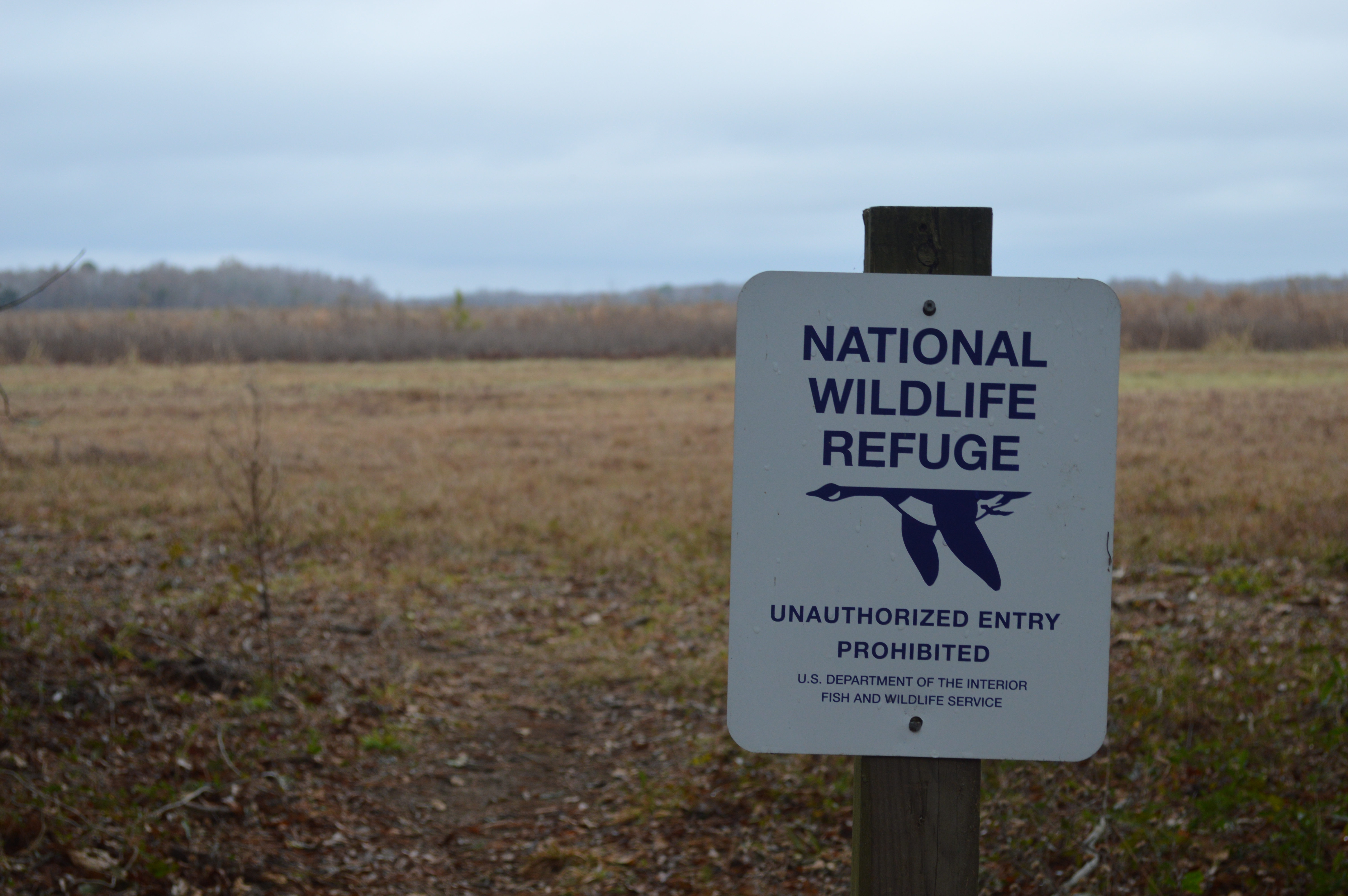
How’d I find it? Wildlife refuges are part of the park travelers site I belong to, and I’ve found them to be great hidden gems. I almost always see large birds of prey, and they are almost always quiet. The National Fish and Wildlife Service tagline is that Wildlife Comes First (and it’s true, the Park Service is about conservation and enjoyment. Refuges can have visitor services, but the intent is for spaces for wildlife. For this, they also call themselves the hidden gems of public lands)

Don't go in.

What was notable? The refuge had most of the area blocked off since migrating birds were on their way in and out. I did see some flocks of birds in the distance at the very edge of the walkable space, but the signs clearly stated don’t go in.

The most interesting spot for me happened to be more historical, rather than natural, which is unusual for such a nature forward spot. The Refuge is on the shores of Lake Marion. Most people would know the lake from driving over it on Interstate 95, and it has it’s own history for being one of the first hydroelectric dammed lakes in South Carolina. Before the lake was created, the Santee and Cooper rivers provided paths of travel between Charleston and spots further inland.

The Santee tribe constructed a burial mound near the current lake site, which was taken over by the British as part of a system of forts between Charleston and inland South Carolina. The Fort Watson site was targeted by Light Horse Lee and Francis Marion (The Swamp Fox!) I had read about Marion before, but never stepped in his footsteps before. He was seen as one of the inspirations for the Mel Gibson movie The Patriot and took part in what would be called unconventional warfare.

The Americans decided to build a tower to shoot down on the fort, and were able to capture the fort from the British and end control of the river and the road connections into the state.

This slideshow requires JavaScript.

What was my takeaway? It was a quicker trip, but full of surprises. The place was quiet, and had views of the lake and low country. I was able to take in southern views of Spanish moss on trees, and seeing local folks fishing. The nature trail was a nice look into swampy areas that would usually be submerged and then spot flocks and flocks of birds flying south for the winter.

The added historical spot was a great find as well! It’s a mix of Native American history, that’s often under looked, and a less known American victory in the Revolutionary War. I think overall, the Revolutionary War gets far less attention than it deserves. We all know of the politicians working in Philadelphia during the War, but I can hardly remember any mentions of the Swamp Fox during school.

Francis Marion himself presents a challenge of history though: if America had lost, we would think of him as a guerilla terrorist, operating in the shadows and swamps. As a patriot on the American side, he’s seen as the founder of special forces in the USA. History is always written by the winners like that!

Posted in National Wildlife Refuges | Tagged , | Leave a comment

Vermont State House

The Vermont State House is in Montpelier, VT which is the smallest state capital in the United States and the only state capital without a McDonald’s. The capitol is located in front of a forested hill and faces the Winooski river, on its journey to Burlington and Lake Champlain. The location near the river places the

Vermont refers to the capitol building itself as the State House. States do vary in what they call their buildings: Some are State Houses, some are Capitols, and there’s a Legislative Hall in there too.

Look with pride on the Golden Dome – “These Green Mountains” – The Vermont State Song

What I love most about the nature of the Vermont State House is the fact that it is so integrated with the town and the rest of the state. It’s not uncommon to have concerts in the House of Representatives chamber that bring the public into the seats of the chamber to enjoy an evening in a stately environment.

The Vermont House Chamber.

The red chairs in the background are for guests of the House to be recognized. Vermont sports teams, civic organizations, or individuals of note can be found observing a session where they also receive a resolution on their prowess.

One of my favorite memories from high school took place in the Vermont State Senate chamber, as my high school team competed in the We The People state finals competition. The final hearing of the day took place in the Senate Chamber, and my group had the highest score of the day in a wonderful setting.

The building also features portraits of important Vermonters through history, including Calvin Coolidge, Admiral George Dewey (Hero of the Spanish American War and interred in the National Cathedral), and previous governors. Most are staid looking portraits of older white men wearing suits and looking serious. A more recent governor who achieved some national acclaim has a different sort of portrait known as “LL Dean”

Governor Howard Dean

The ground floor of the building also features a bust of Abraham Lincoln by Larkin Goldsmith Mead, brother of the Mead of McKim, Mead and White.

A large reception room is named after a battle in the Civil War where Vermonters were an integral part of a Union victory. A portrait hangs in the room as well, with a copy of the Vermont State Coat of Arms hanging above. The State of Coat of Arms is what is on the Vermont state flag, but is not the same as the State Seal. They both feature similar features, and the original seal was designed by Ira Allen.

An art deco state office building faces the State House across the street. The front doors feature a representation of Ceres, with many allusions to the maple industry in Vermont. She holds a representation of the Coat of Arms in her hand as well:

Vermont was the first ever state capitol that I had visited, but was only the start of a larger journey across the United States. Since I do get back to Vermont a few times a year, I might return again to add some more photos, and get some better views of the chambers.

Posted in Capitols | Tagged , | 2 Comments